

Although tech is considered a male-dominated sector, Namagembe is one of the many females breaking this narrative with her passion about youth empowerment and her fellow students at Isbat University Kampala through their tech project, Kwetu hub.
According to the “State of the Tech Workforce 2024,” published in March 2024 by CompTIA, a nonprofit professional and IT certification association, women occupy 27% of tech occupations versus 49% of all occupations,”
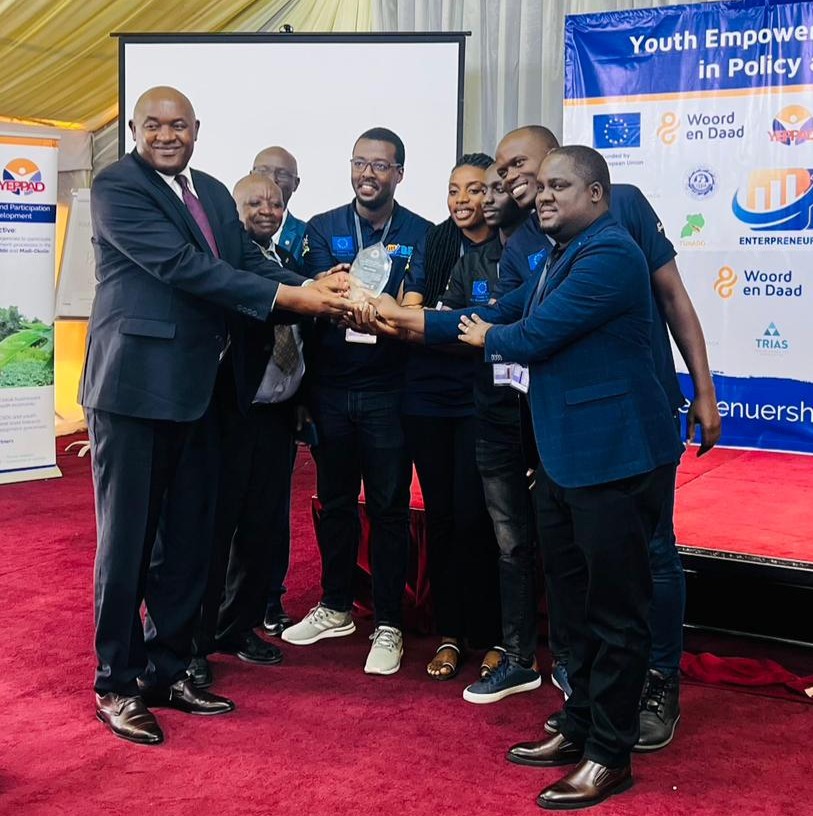
After their recent victory as winners of the Entrepreneurship Booster Platform Hackathon Pitch under the Youth Empowerment and Participation in Policy and Development project, a European Union-funded project in Uganda.
The hackathon was organized by Woord en Daad in collaboration with TUNADO, Trias East Africa, and USSIA, our reporter had a deeper conversation with her.
- How would you describe yourself in a few words?
Alice Namagembe is an artificial intelligence and machine learning engineer working with Tufuna Technologies. She is the regional lead at the Young AI Leaders Kampala Hub under AI for Good and is passionate about building technology that supports mental health and empowers communities.
- What inspired you to participate in the Entrepreneurship Booster Platform Hackathon Pitch Event?
What drew me to the Entrepreneurship Booster Platform Hackathon Pitch Event was the chance to collaborate with brilliant minds, sharpen my entrepreneurial skills, and push a concept from dream to execution. It’s a rare space where innovation meets mentorship.
- Can you give us a brief overview of your project, what is it called, and what inspired the name “Kwetu”?
Our project is called Kwetu Hub. “Kwetu” is a Swahili word that means “our home.” We chose this name because we want young people to feel that this platform is truly theirs, a safe and supportive space where they can find opportunities, guidance, and a sense of belonging.
Kwetu Hub is a digital platform, both web and mobile, that brings together everything a young entrepreneur needs: access to grants and training, mentorship from experienced people, practical business tools, and even a marketplace to showcase and sell their products.
- What specific challenges faced by youth in the West Nile region does your project aim to address and how do you envision Kwetu making impact in communities like Nebbi, Zombo, and Madi Okollo?
For youth in places like West Nile, the challenges are even sharper, such as limited access to information, a few mentors nearby, and weaker market linkages. Kwetu Hub directly tackles these obstacles by offering:
Offline access through USSD, so even without internet, young people can still connect.
Aggregated opportunities, meaning they don’t miss out because of distance.
Mentorship and peer networks that cross borders, linking a youth in Zombo to a mentor in Kampala or beyond.
At its heart, Kwetu Hub is about breaking isolation and giving young people in every region, including West Nile, the bridge they need to turn ideas into businesses and create jobs for their communities.
Kwetu Hub makes opportunities accessible to youth in Nebbi, Zombo, and Madi Okollo by bringing grants, trainings, mentorship, and a marketplace into one platform that also works offline through USSD. This means even in areas with poor connectivity, young people can still access resources, connect with mentors, and showcase their businesses beyond their districts.
- Could you share some features or aspects that make it especially relevant to the youth in this region?
What makes the Entrepreneurship Booster Platform Hackathon especially relevant to the youth in this region is its focus on real, hands-on problem solving. It gives young innovators access to mentorship, funding pathways, and a platform to pitch ideas that directly address challenges in our communities. It’s not just about theory; it’s about skills, collaboration, and exposure to networks that can help them turn their ideas into actual businesses.
- What was your experience like working on this project and presenting it during the pitching session?
Working on this project has been exciting and eye-opening; it pushed us to really understand the challenges youth face and think about solutions that are practical, not just ideas on paper. The pitching session was a highlight for me because it gave us a chance to share Kwetu Hub with others, get feedback, and feel the energy in the room when people connected with our vision. What stood out most was the realization that this isn’t just our project; it’s something bigger that can genuinely transform youth lives.
- Not many women choose to pursue careers in tech due to the high levels of marginalization. What inspired you to take this path?
I chose a career in tech because I believe technology is one of the strongest tools we have to solve real problems, and I didn’t want to stand on the sidelines while others shaped the future.
Yes, it’s true that women are often marginalized in this space, but that’s exactly why our voices and ideas are needed here.
- Also, could you share a message of encouragement for young women who might feel that tech is only for men?
To the young women who feel tech is “for men,” I’d say this: the table will always look male-dominated until more of us take our seats. Don’t wait for permission to step in, learn, and claim your place. The future of tech needs women, and the future of our communities depends on it.